
DAY 2
Chapter 3 - What writing for DC’s Absolute line taught me about comics?

A 24-part story told in real time about how a writer manages his career after the announcement of his two biggest projects.
So Tony Fleecs was one of the first people I mentioned DAY 2 to. Tony’s the Eisner-nominated writer of such comics as STRAY DOGS, LOCAL MAN, and FERAL. He’s sold about a million copies of STRAY DOGS and yet, is still somehow one of the most underrated writers in comics, because he’s just that good. He’s now writing one of my favorite DC characters: DEATHSTROKE THE TERMINATOR, which just launched this past Wednesday. It’s already been deluged by stellar reviews, so grab a copy before it sells out, because I have no doubt it will soon. It’s fantastic.
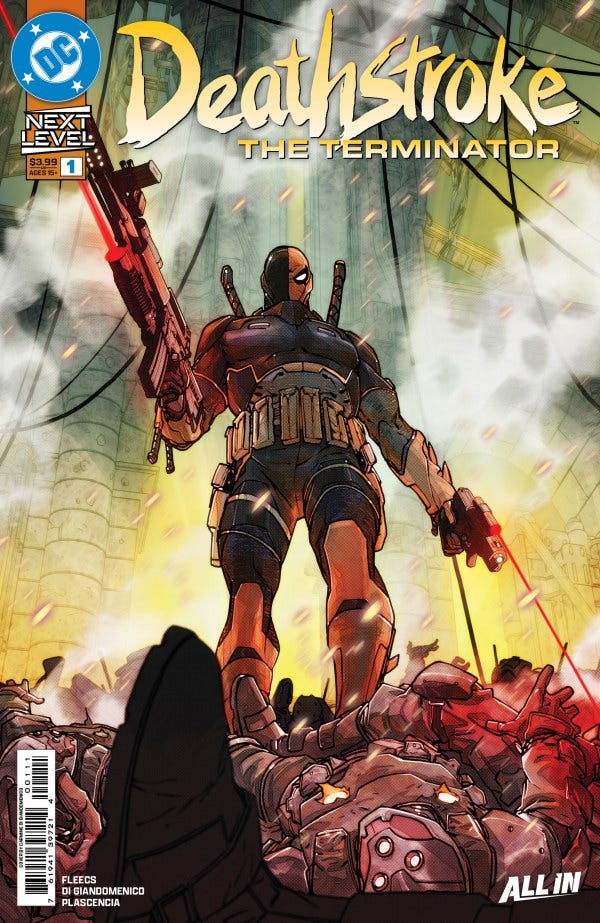
And whenever I’d bring DAY 2 up to Tony, he’d say, “You’re going to talk about your new theory of comics in it, right?” And every time, I promised I would.
So this is me talking about my new theory of comics. Blame Tony if it’s boring. Because this entry is turning out twice the usual length. And I’m going to stress it’s all theory. I’m sure there’s lot of places to poke holes, (I can see some of them on a re-read, but pre-offering my counter-arguments would make me even more monstrously behind on deadlines). So take this as a conversation prompt I hope you find interesting.
But since I was writing an Absolute book, I looked at how different Absolute writers regarded theirs, this leading me to a Substack post written by Absolute universe architect and writer of comics juggernaut ABSOLUTE BATMAN, Scott Snyder. In it, he says some very smart things (because Scott is very, very smart) about writing for the current comics market. You can find that here:

It’s been months, and I’m still obsessed with that post. Coupled by that is how DC’s Absolute line has not just been the mega-hit the comics industry desperately needed, but also that unicorn everyone in comics hopes for: comics that bring in new readers, a large portion of them in that coveted 18 – 32 range.
And that along with Scott’s insight into the comics market led me to the following theory that admittedly sounds rather obvious:
I think the core audience of direct market comics – single issue comics regardless of genre, an outgrowth of superhero comics – are people who want to feel like they’re in their 20s – regardless of how old they actually are.
But as obvious as that sounds, stepping that through, there are 3 different types of groups who want to feel like they’re in their 20s:
(1) People younger than their 20s
(2) People in their 20s
(3) People older than their 20s
Nothing groundbreaking about that breakdown, so let’s project what those groups might want out of their reading experience.
(1) People younger than their 20s who want to feel like they’re in their 20s want something that feels smarter and less inhibited than what’s aimed towards them. That’s been written about a lot. They want to feel precocious.
(2) Meanwhile, people in their 20s wants something that feels authentic and relevant to what they’re going through. They can feel something phony.
(3) And people older than their 20s who want to feel like they’re in their 20s are presumably looking for something with the abandon and energy they miss from when they were younger, with just a hint of the familiar so they can feel safe. Because as much as they want to feel like they’re in their 20s, they’d rather avoid the worrying about rent and dating that random crazy person drama.
So going off that logic, the bullseye of a reading experience that has something for all three of those groups is something with:
(1) Intelligence
(2) Abandon / Lack of inhibition
(3) Authenticity
(4) Relevance
(5) Energy
(6) And a hint of the familiar
And when I look at all the Absolute books, but especially ABSOLUTE BATMAN, I feel like they easily hit those criteria. And I feel the same about the Ultimate and Energon books too, regardless of what age the characters actually are.
And sure, maybe you can say that any good comic should have those qualities, but the whole extrapolation got me thinking about 20-somethings in comics, which led me to a different rabbit hole: Because the two biggest publishers in comics – Marvel and DC – used to routinely hire 20-something writers way more than they do now.
Through the entire 20th century, in fact, it was very common for the Big 2 to hire 20-somethings. Joe Simon and Jerry Shuster were around 23 when ACTION COMICS # 1 was published. Jim Shooter was famously younger - 13 when he started writing SUPERBOY AND THE LEGION OF SUPER-HEROES. Inspired, Paul Levitz was 21 when he started writing LEGION OF SUPER-HEROES. Stan Lee was 19 when he started writing comics. And although he was 39 when he created the Marvel Universe, much has been written about how obsessed he was that college students liked Marvel. It’s also interesting to note that when it was time to find someone else to write in the Marvel voice besides him, he went to Roy Thomas who was 25. And while Lee experimented with other writers to help Thomas, he eventually went with Denny O’Neil, who broke in at 27 (all this taken from Sean Howe’s THE UNTOLD HISTORY OF MARVEL COMICS).
Even as late as the 1990s, Marvel and DC hired 20-somethings for ongoing books, including Garth Ennis (21 when his HELLBLAZER run started), Warren Ellis (26 when he wrote HELLSTORM), Ron Marz (26 when he wrote SILVER SURFER) Mark Millar (24 when he wrote SWAMP THING), Brian K. Vaughan (23 when he wrote SWAMP THING), Geoff Johns (26 when he wrote STARS & S.T.R.I.P.E), to name just a few. But in the late 1990s, based on the strength of DC Vertigo and THE SANDMAN, DC Comics developed a trade paperback program that led comics to no longer be disposable. They could sit on bookshelves and sell for decades to come – yielding a creator royalties in the process.
And as royalties and shelf life became more substantial, the Big 2 took less chances on younger writers. By the aughts, Editor-in-Chiefs of both Marvel and DC – Joe Quesada and Dan Didio respectively – publicly stated that aspiring writers shouldn’t expect Marvel or DC to be their first credits. They were looking for writers with produced credits, whether they came from indy comics, film / TV, or novels. ) This was actually a new stance for the Big 2.
And as comics got less disposable, more Hollywood TV and film writers were lured to write them, probably most notable was Joss Whedon, whose BUFFY THE VAMPIRE SLAYER, FIREFLY, and DOLLHOUSE TV shows were all canceled before he brought them to comics, a move which would eventually lead him to write ASTONISHING X-MEN for Marvel. And it sure seemed Whedon found new relevance amongst the nerd crew in the process. I’m not saying X-Men led him to direct AVENGERS in 2011, but it certainly didn’t hurt him. And while writers like Kevin Smith and Sam Hamm were writing comics before Whedon, those always seemed more like bucket list side gigs. I’d argue after Whedon, more TV and film screenwriters wrote monthly comics as a path for career growth.
And while 20-somethings would still break into comics, they were markedly less. In the aughts, we saw G. Willow Wilson (25 when she wrote CAIRO for DC Vertigo), Sterling Gates (25 when he wrote SUPERGIRL), and Kyle Higgins (26 when he co-wrote BATMAN: GATES OF GOTHAM) to name a few. In the 2010s, there were James Tynion IV (25 when he wrote TALON) and Marguerite Bennet (27 when she wrote DC COMICS: BOMBSHELLS), both students of Scott Snyder.
Of course, there were still 20-somethings making comics, either on the indy scene or with smaller publishers. It just became much more common for writers to break into the Big 2 writing in their 30s, which was the case for Scott Snyder, Jeff Lemire, Jason Aaron, Brian Michael Bendis, Ed Brubaker, Kieron Gillen and more. (I’ll let you guys google the exact ages and projects on your own….)
But the 2000s into the 2010s led to another interesting trend: The boom and bust of corporate consolidation in comics, where comics were seen as R&D for movies and TV. That meant the Big 2 would publish comics they knew might not make money if it could serve as a basis for a TV show or movie, because that’s where the bigger money was. With that, a comic’s audience didn’t just have to be people in comics stores, something Scott Snyder talks a lot about how media development money shifted the bullseye from the true market of comics. And for non-Big 2 books, it meant a comic creator could make more money from a media option than from book sales. I can speak to this personally. By 2018, even though INFIDEL was always intended to be a comic first, I ended up making more money from the film option than from sales of the book. All of this led creators to go where the market was, so it wasn’t the end of the world if your book wasn’t the exact thing the direct market wanted.
Add to that a generation of writers who aged alongside the Direct Market. These were creators born around the same time as the direct market in their 70s or when DC and Marvel first released product tailored to the direct market in the 80s. This generation was in their teens and 20s when the Image Revolution happened. I consider myself one of this crew and the lesson I – and I think other creators of my generation – learned was, oh, as I grow older, so does the comics audience, so as long as I stay true to my creative north star, there will always be people like me hungry to read it.
What I find interesting is how all these tangents are coming together now. You have an industry that stopped hiring 20-something writers to write their books. Creators who lacked incentive to write to that audience because of Hollywood option money. And then the natural aging of a generation of creators so their first instinct might no longer be writing about feeling like they’re in their 20s. So perhaps when an ABSOLUTE BATMAN comes along that has all the intelligence, abandon, energy, relevance, authenticity, with a hint of the familiar that everyone who wants to feel like their 20s wants, it reminds us of who direct market comics were always for. Maybe that’s why ABSOLUTE BATMAN feels like the most organically successful comic in the past 25 years. To me, it says a lot that when Scott did press on his New 52 BATMAN, he talked about what Batman meant to him, but with ABSOLUTE BATMAN, he’s looking to his teenage son as inspiration.
If that’s true, does that mean if I want my comic to have a healthy audience, it needs to feature the exploits of 20-somethings? Well, the truth is, I don’t know. This is all theory. But I honestly don’t think so. There are lots of successful comics where you don’t even know the age of the characters. But it does make me wonder, rather than changing what I’m writing to suit the market, maybe challenging myself to write those stories in a way that really delivers on their intelligence, abandon, energy, relevance, authenticity, with a hint of the familiar. And that seems like a noble writing pursuit in general, so I’m trying it with all the comics I’m writing this year.
(It also makes me wonder whose people favorite 20-something comic book writers are at the moment. If you have suggestions, please let me know. It’s easier of course to find 20-something cartoonists, since a writer needs money (or someone else) to fund their comic-writing, so I’d love to hear specifically writers.)
Or maybe this is all horseshit. I’m sure there are numerous holes in my argument, but hopefully there’s enough here to be fun fodder for conversation amongst comics fans - I’ve certainly been having my share when I talk about it with comic creator friends. But maybe not. Maybe there’s too many holes to be worthwhile. Maybe this been an enormous waste of your time. Maybe this isn’t what you come here to read.
I blame Tony.
OUT NOW:
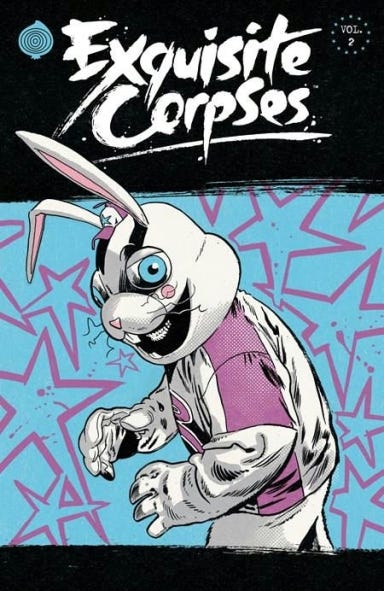
EXQUISITE CORPSES VOL. 2
I’m so immensely proud to be a part of this book. Created by James Tynion IV & Michael Walsh, EXQUISITE CORPSES center on the Thirteen families that secretly rule America. Every five years, they each hire a serial killer and set them loose in a battle royale within an unsuspecting town, the family with the winning killer getting to rule America for the next five years. James and Michael put a writers’ room of creators together in Buffalo to break the story of the townspeople trying to survive the slaughter and now I have a group of people I can’t wait to see again. This volume features my second issue of the series, where I got to work with the gloriously gory artist Adam Gorham and share a volume with some enormously talented comics creators like Che Grayson, Jordie Bellaire, Tyler Boss, Claire Roe, and Gavin Fullerton. I wish every comic I made was as much fun and well run as this.
COMING ATTRACTIONS:
WONDERCON, Storytelling Across Comics, Games, and Beyond panel (MARCH 28, Noon pst)
ABSOLUTE GREEN ARROW # 1 (MAY 20)
TRENTON CHARITY COMIC CON SIGNING (JUN 14, 10 am - 4 pm)
INSPIRATION READINGS:
Love your theory, and agree with its broad strokes.
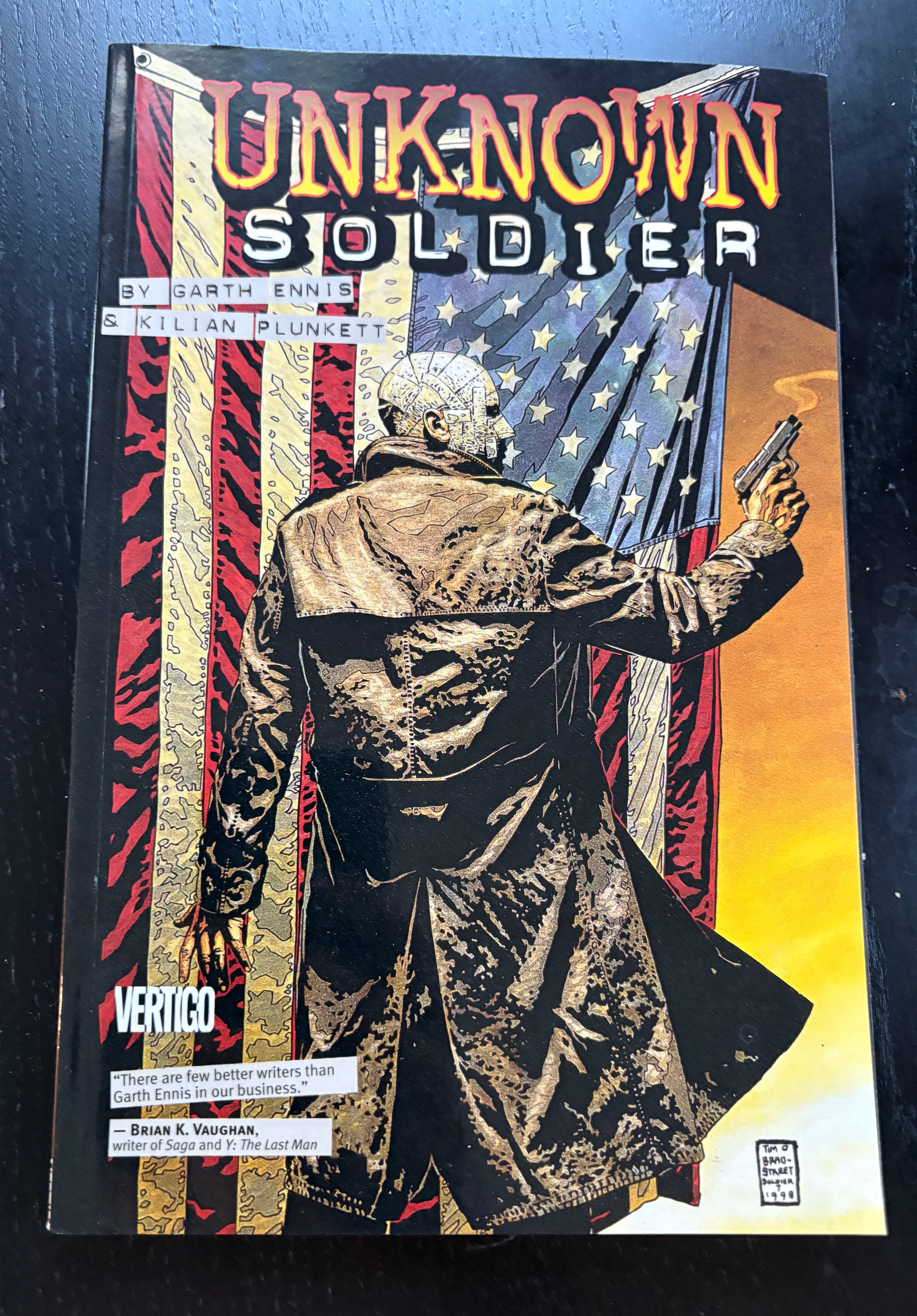
And that Unknown Soldier trade lives rent free in my head, my copy has been read and lent out way too much. The most underrated Ennis I can think of, and I’ve read most of his work. It’s also what I remember as an example of a comic shop hand selling something it truly believed in-and I’m not talking a big market store, I’m talking Oak Leaf comics in Waterloo Iowa-and making it be one one its biggest sellers at the time.
I think about that post from Scott, from time to time as well. Especially as I am so uniquely positioned at the intersection of the industry and it's machinations and fandom. As much as people claim the industry is cyclical, it never quite circles back to the exact same place in the exact same way. In a way, its what makes the comic industry itself nearly as fascinating as the stories that live with in it. Loved the post, Pornsak. Keep it up!